Compounding your Life Force

Remember in the last post, how money can buy you freedom?
The 4% rule. That’s my north star ★ the point where I can safely withdraw from my investment returns to cover my living costs each year, without touching the principal.
Assuming a 6% annual return and around 2% inflation, that leaves roughly 4% to draw down safely, forever. I’m still a long way from there, but I believe I’ll get there eventually, if I persist.
The rough illustration:
Let’s say you accumulate $1 million, invested at a 6% annual return. You can safely withdraw 4% of that, around $40k a year, or roughly $3.3k a month. If your living cost is less than that, you can either spend the surplus on things you enjoy, or leave it to keep compounding.
Main Option
There are many roads to Rome, and just as many ways to reach that north star. The most obvious one: increase your income first. It’s your main wealth driver, unless you’ve inherited millions from your parents. 😛
Then decide your investment strategy deliberately. Time is your friend here, you can start accumulating while you’re young, and let it compound. Imagine saving just $100 a month for 30 years. At a 5% annual return, that turns into roughly $83,000, money you didn’t have to think hard about, just consistently show up for. That’s the kind of retirement fund you should be building. No one is more responsible for your retirement than you are.
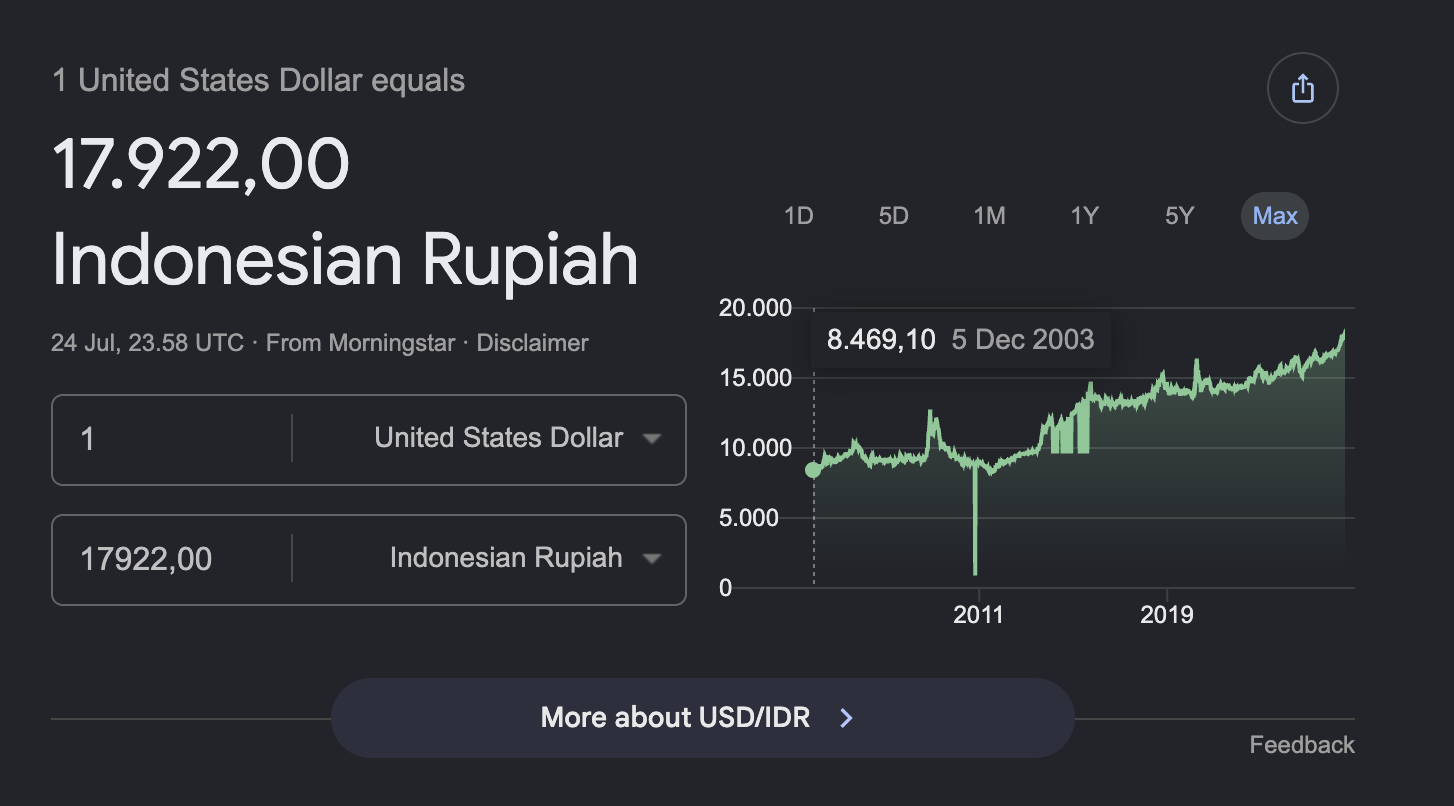
Then there’s the low-cost index fund route. Alas, in Indonesia, we don’t really have that option. The closest equivalent is reksadana, mutual funds. Not to mention their outrageous fees, which can run as high as 3% in some cases, their performance hasn’t been great over the past decade, and it looks even worse in USD terms, since the rupiah has been depreciating this whole time.
Other Options
There are other options too, Indonesian stocks, bonds, term deposits, you name it. But if I’m really trying to hit that north star, none of these vehicles are enough on their own. The IDX Composite has underperformed its regional peers in USD terms over the past decade, well past the commodity boom of 2010.
Imagine spending real time and effort analyzing companies, only to get beaten by the market anyway. I’d rather take the average return and float with the market, it’s not worth losing sleep over. That’s simply because I value my time on my main income vehicle, my actual job. I don’t have the luxury to analyze the market full-time, and even if I did, there’s no guarantee it pays off.
Zoom Out
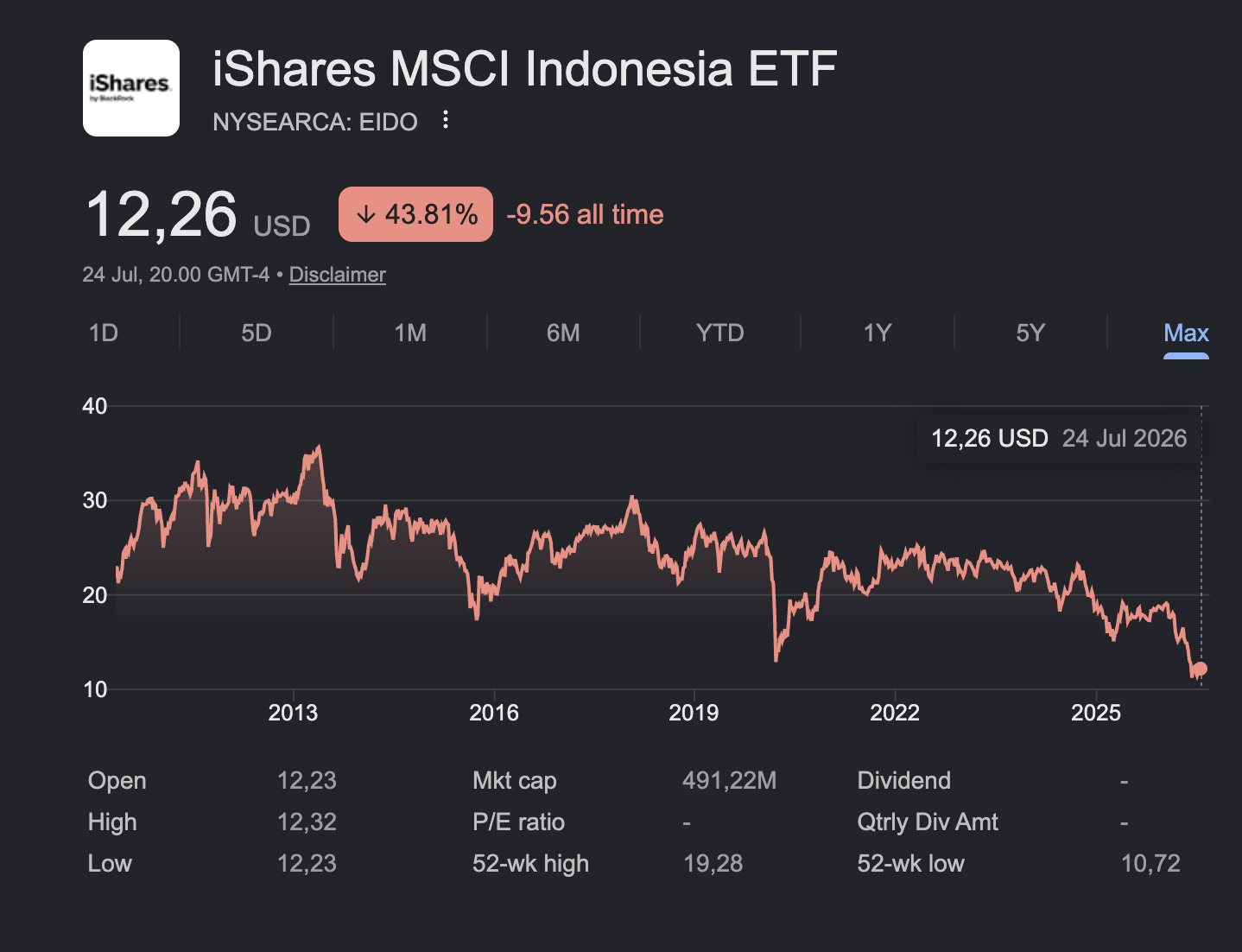
So as Indonesians, we need to zoom out, outside our own country. Some people say VOO, for exposure to the top 500 US companies. Others say VT, to own the whole world. Whatever you pick, the point is to derisk, especially if your income is mainly in IDR.
Given the current macroeconomic conditions, you can’t put 100% trust in a single currency. I don’t want to jinx it, but who knows? could IDR become another Turkish lira or Argentine peso? History rarely repeats, but it rhymes. Better safe than sorry. Diversify your wealth outside your living-cost bucket. Gold is also a good hedging instrument, though portability is a real drawback.
But derisking currency isn’t just about which fund you buy, it’s also about where that fund is legally domiciled, since that quietly decides how much of your money survives taxes and inheritance rules down the line. A US-domiciled fund like VOO or VT can leave non-US investors exposed to US estate tax if your country doesn’t have a tax treaty with the US, a detail most people only discover the hard way. Ireland-domiciled ETFs sidestep this for a lot of non-US investors, which is why they’re worth looking into if you’re going this route.
Conclusion
But don’t get lost in the mechanics. Zoom back out.
This is how you stop trading your life force for money, and start letting money buy some of it back.
Freedom isn’t a number in your bank account. It’s the day your life force finally works for you, instead of the other way around